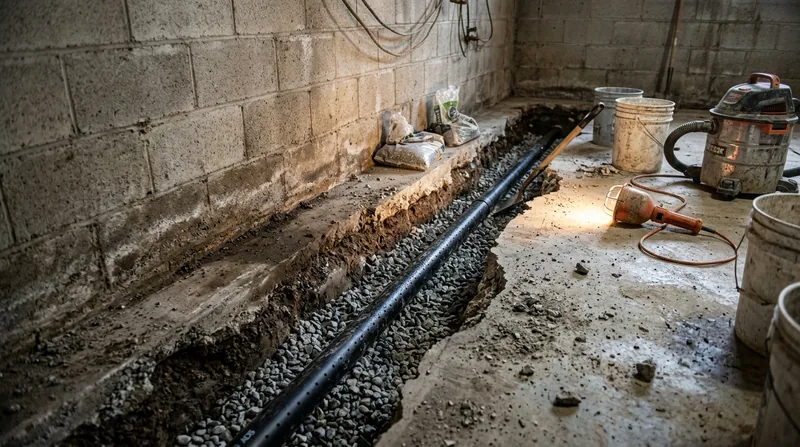


Interior drain tile system in Blacksburg is the answer when spring rain pushes water up through the slab of a 1960s brick rambler off Prices Fork Road or a block basement near downtown. Our ground is clay residuum over weathered limestone and dolomite, so it holds water like a bowl after a storm and swells and shrinks with every freeze-thaw cycle. That water has nowhere to go but up through the cove joint and the slab edge. We cut the slab edge, capture that water at the footing, and route it to a sump basin where a pump moves it outside. It is a below-grade fix built for our soil, not a surface patch. If you are still weighing your options, start with our basement waterproofing overview, then call us at (540) 418-3703.
Why Blacksburg Clay Residuum Makes Interior Drain Tile the Right Call
The older town core, Merrimac, and the ridge subdivisions all share one problem: heavy clay soil that sheds water instead of draining it. After a spring storm, hydrostatic pressure builds under the slab and finds the weakest joint. That is the seepage you see along the wall base at 2 a.m. after a downpour, and it is the failure mode that dominates here.
- Clay residuum traps perched water above the water table, so basements that were dry in August weep in April.
- Freeze-thaw cycles open old mortar joints in stone and brick foundations near downtown, letting water track down to the footing.
- Ridge homes on sloped lots in the 1990s to 2010s subdivisions collect hill runoff at the walkout wall, not the front wall.
- Partially finished block basements in Prices Fork hide the seepage behind paneling until efflorescence and a musty smell show up.
- Springs and sinkholes in the Great Valley geology send water sideways under slabs that have no footing drain at all.
An interior perimeter drain intercepts that water before it reaches your floor, and it works in any season because the work happens under the slab, not in frozen clay outside.
Key info: A 1970s split-level in Merrimac had water standing an inch deep along the back wall every March. The footing drain was clay tile that had collapsed. We replaced it with an interior perimeter drain and a new sump basin, and the slab stayed dry through the next spring storm cycle.
Permits and code questions for below-grade work are handled by the local building department, and rules vary by jurisdiction, so verify before you schedule. You can find the Town of Blacksburg permitting resources at blacksburg.gov.
How We Install an Interior Drain Tile System in Blacksburg
We start with a free basement inspection to confirm the water is coming from hydrostatic pressure and not a single failed crack. If crack sealing is enough, we tell you that. When the whole perimeter is wet, the interior drain is the honest answer, and here is the sequence we run.
- We map the slab, the footing depth, and the sump location before any concrete comes up.
- We saw-cut a channel along the slab edge, about 12 inches wide, and break it out cleanly.
- We dig down to the footing and clear the old weeping tile or clay tile if it is there.
- We set a perforated drain tile in washed gravel with a filter fabric sock to keep clay fines out.
- We install the sump basin at the low point and tie the perimeter run into it.
- We backfill with gravel, pour new concrete over the channel, and test the pump with a full basin.
Expect one to three days for a typical 1,000 to 1,500 square foot basement, and we keep the work area contained so the rest of the house stays usable.
Key info: On a walkout basement in the Ridgewood area, the uphill side was dry but the downhill slab edge was soaked. We ran the interior drain along the uphill and side walls only, tied it to a sump basin with a check valve, and discharged to daylight down the slope. That saved the homeowner the cost of cutting the whole perimeter.
If your existing drain tile has collapsed, our drain tile repair and replacement page covers the diagnostic side before we cut anything.
Interior Drain Tile Approaches We Use in Blacksburg
Not every basement gets the same system. The soil, the footing depth, and whether the lot slopes decide the layout, and we match the approach to the house rather than selling one package to everyone.
| Approach | Description | Best for |
|---|---|---|
| Full interior perimeter drain | Drain tile runs along all four walls under the slab edge and feeds a single sump basin. | Block basements with seepage on multiple walls after heavy rain. |
| Partial interior drain | Drain tile runs only along the wet uphill and side walls, with a shorter trench and smaller footprint. | Walkout basements on sloped ridge lots where only two walls take water. |
| Interior drain plus footing drain tie-in | New interior run connects to a functioning exterior footing drain where the old weeping tile still flows. | Homes where the exterior drain is partly alive but the slab edge still weeps. |
| Drain tile with dimple board and vapor barrier | Drain tile plus a wall membrane and vapor barrier to control moisture wicking through the block. | Partially finished basements with efflorescence and a musty smell. |
| Drain tile with battery backup sump | Same interior drain, paired with a battery backup sump pump for storm-driven power outages. | Student rentals and homes where the pump cannot fail during a spring storm. |
We pick the layout on site, after we see where the water actually enters, not from a phone description.
Interior Drain Tile System Cost in Blacksburg: What to Expect
Most interior drain tile work in Blacksburg starts around $50 per linear foot, and that figure covers the saw-cut, the gravel bed, the perforated tile, and the concrete patch. A 100-foot perimeter run lands near $5,000 before the sump basin and pump, so a full basement system with a new basin and pump typically runs higher. The number moves with the length of the run, the footing depth, whether we hit rock, and whether the old clay tile has to come out.
Access matters too. A finished basement with drywall down to the floor means more careful containment and more patching, and a tight Merrimac lot with no room for a dumpster adds handling time. We give you a written scope with the linear footage and the sump details spelled out, so you can compare bids line for line.
Get two or three estimates and ask each contractor whether the price includes the sump basin, the pump, the check valve, and the discharge line. A low bid that leaves out the pump is not a lower price, it is a smaller job. Our full pricing overview breaks down what each line item covers.
What to Look For in a Waterproofing Contractor Near Blacksburg
Interior drain tile is mostly hidden once the concrete goes back down, so the contractor you pick matters more than the product. Here is what we tell homeowners to check before they sign, and we expect you to hold us to the same standard.
- Confirm the contractor is licensed and insured, and ask for the certificate before work starts.
- Get two or three written estimates with linear footage and equipment listed separately.
- Ask for references from Blacksburg, Christiansburg, or Radford jobs done in the last year.
- Check whether a permit is required for work that alters drainage or the sump discharge connection, and let the local building department confirm the rule.
- Ask how they protect finished walls and floors during the cut and how they handle the concrete patch.
A contractor who cannot answer those questions plainly is not the one you want under your slab. Reach us through our contact page and we will walk your basement with you.
Interior Drain Tile System Near Me: What Blacksburg Homeowners Should Know
If you are searching for an interior drain tile system near me, the first question is whether the water is hydrostatic or a single crack. A wet spot under one window well calls for crack repair or window well drainage. Water along the whole wall base after every storm calls for the interior drain. We serve Blacksburg and the surrounding towns, including Christiansburg, Radford, and Shawsville, and we tell you plainly which one you need.
Our crews work in any season because the trench is under the slab, so a February install is as practical as a June one. Call (540) 418-3703 to schedule a free basement inspection and get a written scope before any concrete comes up.
Interior Drain Tile System in Blacksburg: Pricing Guide
| Service | Price | Details |
|---|---|---|
| Partial interior drain (one or two walls) | Starting at $50/linear ft | Includes saw-cut, gravel bed, perforated tile, and concrete patch; shorter run lowers total cost. |
| Full interior perimeter drain | Starting at $50/linear ft | Covers all four walls plus tie-in to sump basin; footing depth and rock increase the rate. |
| Sump basin and pump package | Starting at $850 | Includes basin, primary pump, check valve, and discharge line; battery backup adds to the total. |
| Complex or large-scale job | On estimate | Finished basements, deep footings, or rock encounters need an on-site look before pricing. |
| Travel | Included | in Blacksburg and surrounding areas, no separate call-out or mileage fee |
| Estimate | Free | Response within 24h at (540) 418-3703, no obligation to book |
Indicative pricing, the exact cost depends on square footage, finish, and site access. Free personalized estimate within 24h at (540) 418-3703.


